WanderX
01 December 2024 • Paolo & Julieta • SEO & Growth
WanderX approached us with an ambitious vision: transform how travelers discover and experience destinations by bridging physical hotel spaces with digital exploration tools. They imagined hotel lobbies becoming interactive travel planning hubs where guests could explore destinations on large displays, then seamlessly transition to mobile devices for augmented reality-enhanced city walks. The challenge wasn't just designing an app—it was reimagining the entire travel planning and exploration journey across multiple devices and contexts.
The Multi-Device Tourism Challenge
Travel planning traditionally happens in fragments: research at home on laptops, hotel concierge conversations, paper maps while exploring, and disconnected mobile apps that don't know your itinerary. WanderX wanted to unify this experience—creating continuity from the moment travelers arrive at their hotel through every step of their city exploration.
Here's what made this complex: The platform needed to work across three distinct device types with completely different interaction paradigms: large lobby displays designed for discovery and browsing, tablets for hotel staff-assisted planning, and mobile phones for on-the-go navigation and AR experiences. Each device served different purposes, yet the experience needed to feel cohesive—not like three separate products, but one intelligent system adapting to context.
Understanding Traveler Behavior Patterns
The Research Phase
Before designing interfaces, we needed to understand how travelers actually plan and explore. We conducted extensive user research examining decision-making patterns, information needs at different journey stages, technology comfort levels across demographics, and pain points in current travel planning processes.
Key Behavioral Insights
Travelers don't want to plan everything in advance—they want inspiration in the moment. Hotel lobbies represent decision points where travelers actively seek ideas for their day. Most travelers feel overwhelmed by too many options and appreciate curated, personalized suggestions. The gap between planning and doing needs to be minimal—complexity between deciding to visit somewhere and actually going kills momentum.
International Considerations
WanderX serves international travelers of varying tech comfort levels. The interface needed to work intuitively for tech-savvy millennials and less digitally fluent older travelers alike. Visual communication, clear iconography, and minimal text help bridge language barriers and varying comfort with technology.
Designing the Lobby Experience: Discovery at Scale
Large Interactive Display Design
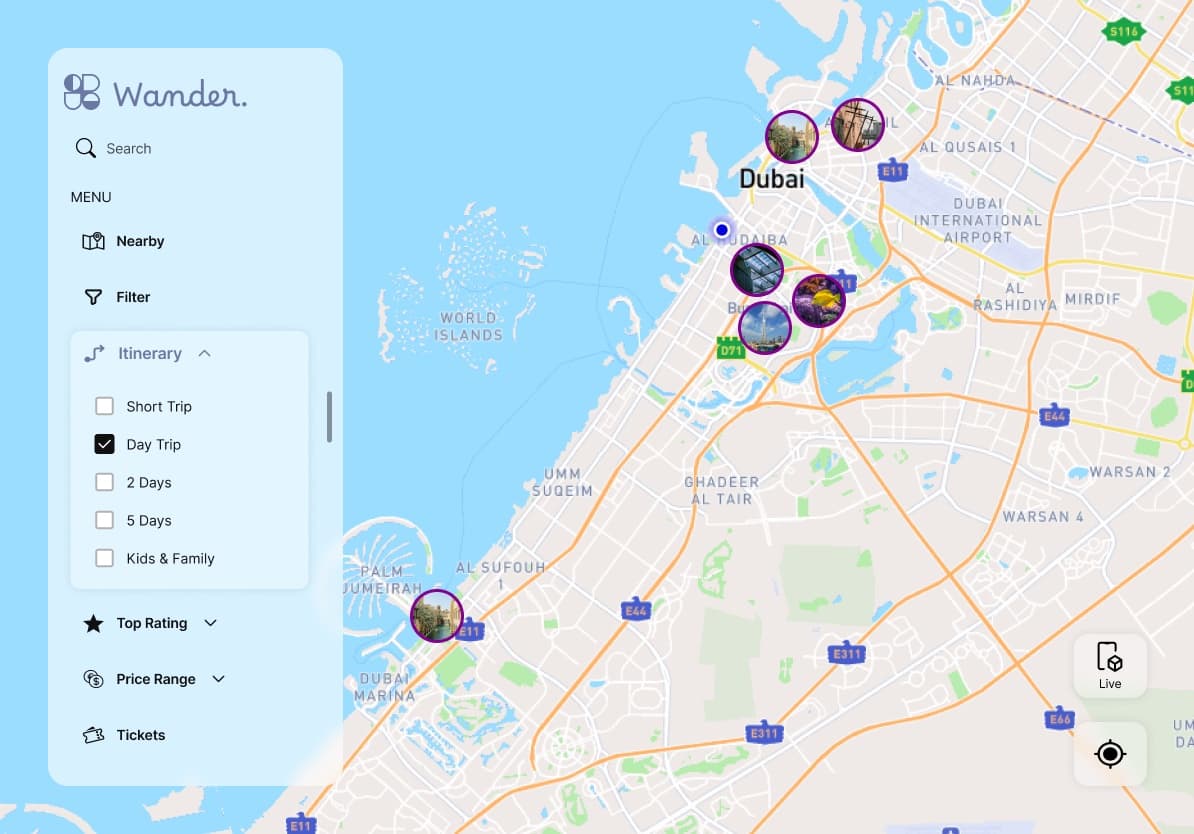
The lobby touchscreen serves as the entry point—where travelers first encounter WanderX and begin planning their day. We designed for this context specifically: map-based interface prioritizing visual exploration over text-heavy lists, large touch targets appropriate for standing interactions, attractive visuals that draw attention from across the lobby, and quick engagement—travelers understand value within seconds.
Curated Route Presentation
Rather than overwhelming users with every possible attraction, we designed curated route suggestions: themed walks combining multiple points of interest, duration and difficulty indicators helping travelers choose appropriate options, visual previews showing what they'll experience, and clear value propositions for each route.
Interactive Map Navigation
The map interface allows intuitive exploration—travelers can zoom, pan, and tap to discover what's nearby, see routes overlaid on actual city geography, and understand spatial relationships between attractions. The interaction feels natural even for first-time users.
The Seamless Transition: QR Code Magic
Transfer Flow Design
The innovation connecting lobby and mobile experiences is elegant simplicity: travelers select their preferred route on the large display, a QR code appears on screen, they scan it with their phone, and instantly receive their personalized itinerary with tickets, maps, and navigation. This transition needed to be effortless—any friction would cause drop-off.
What Transfers
The mobile app receives complete context: selected route with all stops and descriptions, purchased tickets or access passes, optimized walking directions, estimated timing for each segment, and AR content activated for the chosen locations.
Building Trust in the Transition
Travelers needed confidence that scanning the QR code would actually work and provide value. We designed clear visual communication showing exactly what they'll receive, simple instructions without technical jargon, and immediate mobile confirmation that the transfer succeeded.
Mobile Experience: AR-Enhanced Exploration
Navigation Mode
Once travelers leave the hotel, the mobile app becomes their guide. We designed navigation that's simple yet informative: clear directions to the next destination, estimated walking time remaining, current location always visible, and ability to modify routes if plans change.
VR Mode Innovation
The platform's differentiating feature is AR capability—as travelers walk through the city, they can activate augmented reality overlays providing historical context at landmarks, showing what buildings looked like in different eras, highlighting hidden details they might miss, and telling stories that bring locations to life.
Designing for Distracted Use
Travelers using the app are walking through unfamiliar cities—often in bright sunlight, potentially in crowds, and definitely distracted by their surroundings. We designed for this reality: high contrast interfaces readable in sunlight, large buttons easily tapped while walking, audio cues reducing need to constantly watch the screen, and obvious visual feedback for every action.
Brand Identity: Modern Travel Meets Technology
Logo and Visual System
We created the WanderX brand identity to balance exploration adventure with technological sophistication. The logo suggests movement and discovery while maintaining professional credibility. The visual system works across all contexts—from large lobby displays to tiny mobile screens.
Color Palette Strategy
Colors were chosen strategically: vibrant enough to attract attention in hotel lobbies, readable across different lighting conditions, culturally appropriate for international audiences, and distinct from typical tourism branding.
UI/UX Consistency
Despite serving three device types, the interface maintains visual consistency. Travelers recognize the experience whether interacting with the lobby display or their phone—same visual language, same interaction patterns where appropriate, just adapted for context.
Complex User Flows: Wireframing the Journey
Multi-Device Flow Mapping
We mapped complete user journeys across device transitions: arrival at hotel and discovery of the lobby display, exploration and route selection, QR scanning and mobile transfer, walking navigation with AR activation, and completion with feedback opportunities.
Identifying Friction Points
Wireframing revealed potential problems before development: what if QR scanning fails? What if travelers lose mobile signal? What if they want to modify routes mid-journey? We designed solutions for each scenario, ensuring graceful degradation when perfect conditions don't exist.
International Usability Testing
We tested wireframes with diverse user groups representing different ages, nationalities, and technology comfort levels. Feedback shaped final designs—we eliminated confusing elements, clarified ambiguous interactions, and ensured the experience felt intuitive regardless of background.
The Results: Static Lobbies Become Dynamic Hubs
Transformed Hotel Experience
Hotel lobbies gained new purpose. Rather than empty spaces travelers pass through, they became interactive planning centers adding value to the guest experience. Hotels partnering with WanderX differentiate their offering through technology.
Increased Exploration Confidence
Travelers explored more confidently with clear guidance and context. The combination of planned routes and AR enhancement made unfamiliar cities feel accessible, encouraging deeper exploration beyond typical tourist areas.
Seamless Technology Integration
The multi-device experience worked smoothly—travelers didn't feel like they were using three different products. The transition from lobby to mobile felt natural, and AR features enhanced rather than complicated the exploration experience.
Scalable Platform
The design system accommodates growth—new cities, additional features, and expanding device types can integrate without requiring complete redesigns. The foundation supports WanderX's evolution.
Lessons from Multi-Device Tourism Design
Context Determines Interface
The same functionality requires different interfaces on different devices. What works on a 55-inch lobby display fails on a 6-inch phone. Great multi-device design adapts intelligently to each context.
Transitions Matter Most
The magic isn't in individual device experiences—it's in how smoothly users move between them. QR code scanning needed to be effortless because any friction would break the entire experience.
AR Enhancement, Not Replacement
Augmented reality works best enhancing physical exploration, not replacing it. We designed AR features as optional overlays providing additional context—travelers could ignore them and still have great experiences.
International Users Need Universal Design
When serving global audiences, visual communication beats text. Icons, maps, and imagery transcend language barriers more effectively than written instructions.
Ready to Transform Physical Spaces Into Digital Experiences?
For Hospitality Innovators: Your physical spaces can become interactive experiences that add genuine value for guests. The right multi-device platform doesn't just provide information—it transforms how people engage with your space and services.
For Tourism Technology: Creating great travel experiences requires understanding the full journey—not just isolated moments. When you design for continuity across devices and contexts, you create experiences that feel magical.
Ready to design an experience that bridges physical and digital worlds? Book a strategy session with Bona and let's explore how to transform your spaces into interactive experiences. Because the future of hospitality isn't just digital or physical—it's seamlessly both.